Showing posts with label flowers of the week. Show all posts

Tuesday, May 29, 2012

Flower of the Week

Camellia


In the eyes of the Chinese, the symmetrical petals of the camellia flower reflect the spirit of a lady, and the calyx holding the petals represents the young man who will protect her. The calyx of most plants remains after the petals have dropped, but the camellia's calyx falls with the petals when the flower dies. This symbolizes an everlasting union between lovers. In many parts of China, the camellia is considered the most favorable flower to be worn by young people to attract a marriage partner. 

Camellias became the height of fashion as a corsage in 1940s America. In Temple City, California, the first Camellia festival was celebrated in 1945, with people gathering to admire vast floats of flowers. Annual camellia festivals spread across the United States in this decade and in the 1950s. 

Unlike some flowers, which can have negative as well as positive meanings, camellias always symbolize good fortune. Not only are they emblems of love, but they are also lucky, especially when presented to a man. 

The beauty of Camellia flowers inspired Victorian lovers to choose them to express decoration, but different flower colors varied in meaning:

The pink camellia: "I long for you"
The red camellia: "You are a flame in my heart"
The white camellia: "You are adorable"*


*Excerpt from The Secret Language of Flowers, by Samantha Gray

Saturday, April 28, 2012

Flower of the Week


Lily of the Valley

Convallaria majalis


We got this beautiful Lily of Valley into the shop and have been happily breathing in its scent all week long. With May almost upon us, what better excuse did we need to feature it as our Flower of the Week?


Traditionally a symbol of the arrival of spring and of the month of May, Lily of the Valley is the subject of multiple cultural legends. In the Christian tradition, these lilies are known as Our Lady's Tears - the flowers having sprung from the Virgin Mary's weeping eyes during the crucifixion of Jesus. In religious artwork, they are a symbol of humility. 


In the Victorian language of flowers,  Lily of the Valley was a symbol of sweetness, humility, happiness, and purity of heart. It is also sometimes carried by brides for luck, in addition to the traditional something old, something new, something borrowed, and something blue. 


Saturday, April 21, 2012

Flower of the Week: Fritillaria

Fritillaria
Fritillaria meleagris


Our current flower of the week might just be one of our coolest ever, with its purple and white checkered pattern! While we couldn't find any associated mythology or symbolic meaning behind fritillaria (other than the origin of its name - meleagris means "spotted like a guinea fowl"), we're not sure a flower this daring needs a symbolic backstory to get us interested. 


This variety of fritillaria comes in a multitude of colors, but the blooms in our shop are a fantastic bright purple. While commonly grown in gardens and available in bulb form for home cultivation, this flower is actually considered an endangered species in some parts of Europe, including France, Slovenia and Romania, due to the fact that it rarely grows in the wild. In addition, it is the national flower of Croatia.

A close-up of the fritillaria's pretty pattern, peeking out from an arrangement created for a charity benefit. 


Saturday, April 14, 2012

Flower of the Week: Cherry Blossoms


Cherry Blossom
Prunus serrulata

We usually see photos of cherry blossoms en masse, but they're absolutely precious close up!

All around the country, cherry trees are flowering into clouds of pink petals, a beautiful and delightful sight to behold. There are multiple cherry blossom festivals in the United States, the most noteworthy of which is probably the National Cherry Blossom Festival in Washington, DC. Cherry blossoms have a long history and many varied meanings, the most famous of which is the Japanese tradition of hanami - essentially parties organized to view blossoming cherry trees. Originally hanami were philosophical excursions with the purpose of reflecting on the transient nature of life, but have evolved into festive gatherings to enjoy the beauty of nature. 


Japan and the United States have been exchanging gifts of cherry trees as tokens of friendship since 1910. The first trees from Japan were planted in Sakura Park in Manhattan (sakura being the Japanese name for the cherry tree) and along the shore of the Tidal Basin in Washington DC, and this gift was renewed in 1965 with the planting of an additional 3800 trees. In 1981, a fire destroyed a number of cherry trees in Japan, and the United States was able to reciprocate the kindness of the Japanese by offering cuttings from the original trees planted in Sakura Park to Japanese horticulturalists working to restore the cherry tree population. 


In Japan, the cherry blossom is a symbol for the ephemeral nature of life, extreme beauty, and quick death. In Chinese tradition, the cherry blossom stands for the empowerment of women, beauty, and feminine sexuality.

Saturday, March 24, 2012

Flower of the Week: the Pansy


We had this precious jar of pansies on the windowsill today, and what better opportunity than this to snap a cute photo of our flower of the week? 

Pansies are a type of violet that hold a special place in the hearts and minds of writers and storytellers; the symbology behind these little flowers knows no bounds. They were a vital ingredient in Celtic love potions, a fact which Shakespeare referenced in his master comedy A Midsummer Nights' Dream when Fairy Queen Titania awakes with pansy juice and falls in love with the first creature she sees. 

According to folklore, it was commonly believed that the petals of pansies had the power to heal a broken heart, and courting Victorian lovers often exchanged these flowers on St. Valentine's Day. One German legend says that pansies once had a wonderfully strong scent that was so enticing that people came from far away to smell them, and in the process trampled the surrounding fields. The cattle in these fields found themselves with nothing to eat, and the pansies prayed to God for help. God then took away the pansies' scent and gave the flowers great beauty instead.

Pansies stand for great charm, a gentle, loving nature, and loyal friendship.*


From The Secret Language of Flowers, by Samantha Gray. 


Saturday, March 10, 2012

Flower of the Week: the Forget-Me-Not


Forget-Me-Not
Myosotis arvensis


A symbol of true love, hope and remembrance, the Forget-me-not was  once considered a wildflower, rather than a garden plant. By the latter half of the nineteenth century, bunches of these small blue flowers were being sold in Parisian markets "for the purpose of making the gift of love and friendship." At the same time in Germany, leaving forget-me-nots on the graves of loved ones was common.

This flower's botanical name comes from the Greek word for "mouse ear," a reference to the shape of the plant's leaves. A common legend of the forget-me-not's origin is the tale of a young couple who were walking beside the Danube when they spotted some blue flowers in the river. The young man dove in to fetch them for his love, despite her protests that the river's currents were too strong. He picked the flowers and had almost reached the river bank when he was caught in the whirl of the current. He used his last amount of strength to toss the bouquet to her and with his dying breath he called, "Forget me not!" His memory was never far from the young woman's mind, and she wore the blue flowers in her hair for the rest of her life. *


*From Samantha Gray's The Secret Language of Flowers


Friday, March 2, 2012

Flower of the Week: the Bluebonnet

Texas Bluebonnet

Lupinus texensis

"The bluebonnet is to Texas what the shamrock is to Ireland, the cherry blossom to Japan, the lily to France, the rose to England and the tulip to Holland." 
- historian Jack McGuire


image via Flickr


In honor of Texas Independence Day, we're posting our next Flower of the Week a day early. The Bluebonnet is the state flower of Texas and a fierce source of pride for Lone Star State natives. Because the bluebonnet is an official symbol of our state (which is the only place in the world that two of the five official state bluebonnets grow naturally), it is illegal to pick these flowers where they grow wild in fields and cover the sides of our roads in a riot of vivid blue hues. 

Last week we saw bluebonnets start to pop up along the highways, a sure sign that spring is here to stay, and remembered the American Indian folk tale of how bluebonnets came to be: A young Comanche girl sacrifices her most beloved doll to the gods in a prayer for much-needed rain to save her people from a drought, and her sacrifice is answered with a beautiful gift. Read the tale in full here.

Happy 176th Birthday, Texas! 


Saturday, February 18, 2012

Flower of the Week: The Crocus

Crocus
crocus longiflorus


image via Flickr


In the day of Queen Victoria, the crocus was the symbol of Gladness and was meant to be a word of caution and to not abuse.

Funny, with Valentine's Day just behind us, Crocus was dedicated to Saint Valentine and appears to pop up around this time of the year.  Eager for that early pollen, after the winter months the Bee makes the cup of the crocus open.

The scent of crocuses is mysterious and alluring and has been said to dispurse drowsiness and quicken the pulse.  It is said that Cleopatra made an oil for her hands from this sweet flower.  In Greek mythology, Homer put crocuses in the bed of the King and Queen of Heaven. 

I don't know about you but, I am so ready for these early blooms and hope to see them growing in gardens very soon.

Monday, January 30, 2012

Flowers in Season: January 30 - February 5

Honeysuckle


WOLLERTON_OLD_HALL_GARDEN_JUNE


Honeysuckle, named for its strong and sweet scent, is a hardy climbing vine-like plant with blooms that range from yellow to pink to fuchsia in color. Its resilient nature has led to its association with lasting bonds of love and friendship, generosity, devoted affection, fidelity, sweetness, happiness and spiritual vision. 

In Scottish tradition, honeysuckle is used in garlands and decorations for wedding ceremonies to represent the love that holds on through both good and bad times. In France, the custom of giving honeysuckle to a partner is a demonstration of everlasting love. Another common European tradition is the planting of honeysuckle to foretell of an upcoming wedding. 


If you have a love of honeysuckle, your kindness to others is steadfast.  Like honeysuckle itself, a person who fascinated by honeysuckle would demonstrate the characteristics of resilience and steadfastness in your relationships.  No one would doubt that you can be trusted and relied on, always.

Monday, January 16, 2012

Flowers in Season: January 16-22

Forsythia
 Oleaceae Forsythia

image via wikipedia

Forsythia, native to East Asia and Southeastern Europe is named in honor of Scottish botanist Robert Forsyth. Forsyth was a royal head gardener and founding member of the Royal Horticulture Society.

Forsythia is a popular early spring shrub in gardens and parks.  It is a lovely branch that can be used in floral design, either alone or in arrangements.  They are prized for being tough, reliable garden plants.

Monday, January 9, 2012

Flowers in Season January 9-15

Carnation
 Dianthus

image via here

Carnations are one of the world's oldest cultivated flowers and thought to have originated in East Asia. The botanical name can be translated as "flower of the gods" as the Greek word "dios" means "divine" and "anthos" means flower. Some scholars believe that the name comes from the word "coronation," because the flowers were used in Greek ceremonial crowns.*

Different colors have different meanings:
Pink - Mother's love
Light Red - Admiration
Dark Red - Deep Love
White - Pure love & Good luck

*Excerpt from The Secret Language of Flowers by Samantha Gray

Sunday, January 1, 2012

Flowers in Season January 1- 8

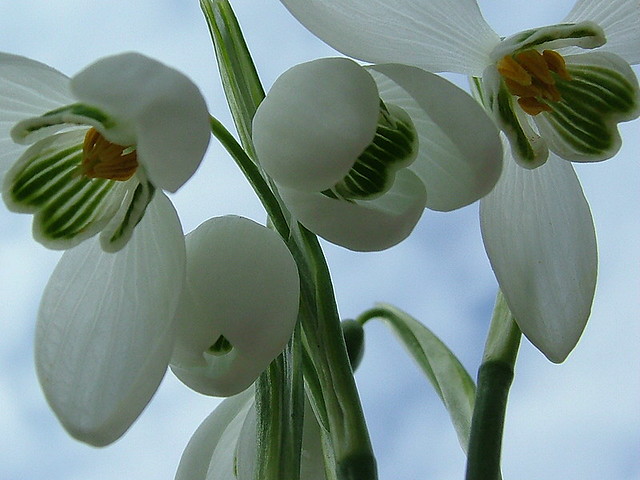
Snowdrop
Galanthus Nivalus

image via Flickr


Snowdrops, which originated in Switzerland and Austria, begin flowering in January and are a symbol of hopefulness and new beginnings, which makes them a perfect flower for the start of a new year. 

In German folklore, a snowdrop myth tells the tale of how God created all the things on Earth, but the snow was sad to find itself icily transparent and invisible. God told the snow to ask the flowers if they would give it some of their color. The snow asked each flower in turn and every one of them refused, leaving the snow sadder than ever. Finally, the snow asked a little white flowers, which agreed sweetly to let the snow have some of its pure whiteness. In perpetual gratitude, the snow allows its friend the snowdrop to be the first of the flowers to bloom each year.*


*excerpt from The Secret Language of Flowers by Samantha Gray

Sunday, December 18, 2011

Flowers in Season, December 18 - 24


Christmas Cactus
Schlumbergera


Native to Brazil and the South American rainforests and not actually a cactus, the Christmas Cactus is named so due to its ability to thrive during the holiday months and the custom of decorating a cactus instead of a tree in warmer countries where cultivating evergreens is not possible.

Due to their popularity, Christmas Cacti have been bred to bloom in a variety of different colors, and are a wonderful way to add a little nontraditional holiday cheer to your home.

Saturday, December 10, 2011

Flowers in Season December 11 - 17

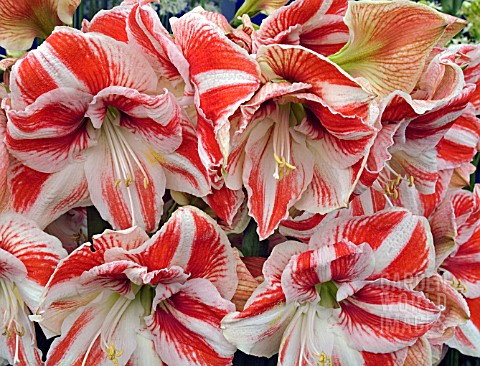
Amaryllis
Hippeastrum

don't these remind you of peppermints?


Native to the Andes mountains of Chile and Peru, the amaryllis was discovered in 1867 and soon became popular with floral enthusiasts the world over due to its large, vibrant petals and tall stems. The word amaryllis originates from the Greek word amaryssein - perhaps a reference to the common star-shaped marking in the center of the blooming flower.

Also known as belladonna, naked lady, St. Joseph's staff and the March lily, the amaryllis stands for radiant beauty, pride, and determination. It is also associated with the astrological sign Sagittarius, which is characterized by a passion for travel and adventure.

To learn how to grow amaryllis from bulbs, check out our tutorial here.
Related Posts Plugin for WordPress, Blogger...